 RigMining
Mining basics
Which Coins Can an ASIC Miner Mine? SHA-256, Scrypt, kHeavyHash and More
ASIC miners are built for one algorithm each. Learn which coins match SHA-256, Scrypt, kHeavyHash, Blake3 and Equihash, and what to check before you buy.
One chip, one algorithm
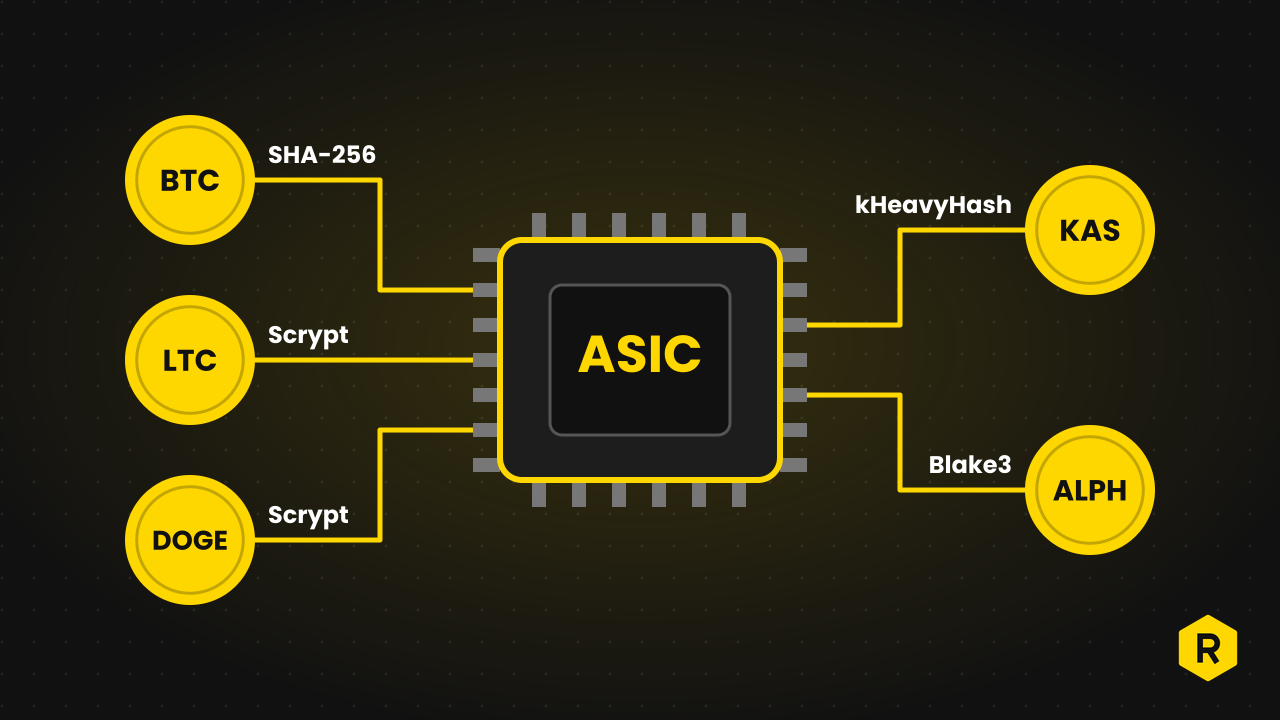
Every proof-of-work coin uses a mathematical recipe called an algorithm. An ASIC is built to run one of these recipes and nothing else. That makes it very fast and efficient, but it also means a machine made for one coin cannot simply be switched to another.
So the first question when you look at a miner is not “how fast is it?” but “what does it mine?”
Algorithms and the coins that use them
| Algorithm | Example coins | Notes |
|---|---|---|
| SHA-256 | Bitcoin (BTC), Bitcoin Cash (BCH) | The original mining algorithm. |
| Scrypt | Litecoin (LTC), Dogecoin (DOGE) | The same machines can mine both through merged mining. |
| kHeavyHash | Kaspa (KAS) | Used by Kaspa ASICs. |
| Blake3 | Alephium (ALPH) | Can also be mined on GPUs, but ASICs are available. |
| Equihash | Zcash (ZEC) | Needs Equihash-compatible ASICs. |
This list is a guide, not a full catalogue. Projects launch and change, so always check the machine’s listing for the exact coin and algorithm.
Merged mining: Litecoin and Dogecoin
Litecoin and Dogecoin share the Scrypt algorithm. A Scrypt ASIC connected to a pool that supports merged mining can contribute the same work to both coins, so you do not need to split your hashrate. The pool handles the extra proof of work and the reward split.
When you estimate earnings, count the merged rewards once, and use the pool’s real payout rules. Reward schemes can differ between the two coins.
You cannot compare hashrate across algorithms
A terahash per second (TH/s) is a unit of speed. You can convert between TH/s and GH/s (1 TH/s is 1,000 GH/s), but converting units does not make the work comparable. A SHA-256 hash, a Scrypt hash and a kHeavyHash are different calculations.
That is why a bigger hashrate number on one machine does not mean it earns more than a machine for another coin. Compare each machine’s estimated earnings for its own coin, minus power and pool fees.
What to check before you buy
- The coin and algorithm. Make sure the machine mines the coin you want.
- Hashrate on that algorithm’s scale. Read the unit carefully (TH/s, GH/s or another).
- Power draw and efficiency. See how to read a spec sheet.
- Pool support. Confirm a pool exists for that coin and see its payout method.
- The project’s plans. Some projects change their algorithm through a software upgrade, which can make existing ASICs obsolete. Read about the coin before you commit.
- Your own numbers. Use that coin’s calculator with your power price. Profitability differs from coin to coin and changes over time.
Where to look on OneMiners
OneMiners lists machines by coin. Start with the collection for the coin you are considering: Bitcoin, Kaspa, Alephium, Litecoin or Dogecoin. Each collection has filters for hashrate, efficiency and cooling. The calculators page has a calculator for each coin it lists.
For the buying steps themselves, follow our tutorial on how to buy a miner on OneMiners.
Sources and further reading
Written by the OneMiners team. We sell and host mining machines, so this article links to our own pages where they are relevant, and the sources above are independent. It explains how things work and is not financial advice. Mining carries risk, and prices, rates and features change, so check oneminers.com for current details.