 RigMining
Profitability
Mining Pool Payouts Explained: FPPS, PPS+ and PPLNS
Pools pay miners in different ways. Learn what FPPS, PPS+ and PPLNS mean, who carries the luck risk, and what to check before you pick a pool.
Why pools exist
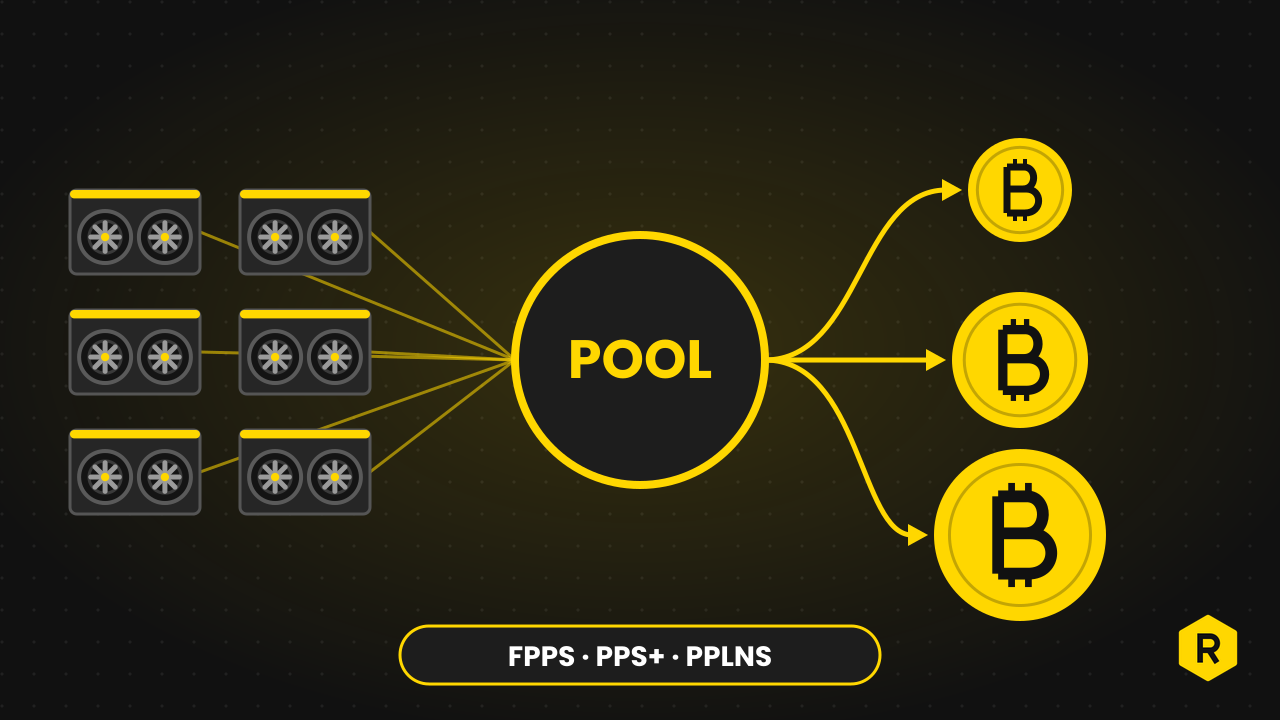
Finding a Bitcoin block is a matter of chance. A single machine might find one rarely, or not for a very long time. A mining pool combines the work of many machines so that blocks are found regularly, and the pool shares the reward among its members.
Pooling does not create extra bitcoin. It makes your income smoother and easier to predict.
What a share is
Your machine sends the pool small pieces of proof that it is working, called shares. A share is not a slice of a Bitcoin. It is an accounting record of work. The pool’s payout method decides how shares turn into money.
The three methods still in common use
Foundry, a large pool operator, lists three payout methods that remain in use for Bitcoin. They differ mainly in who carries the risk of bad luck, the pool or the miner.
FPPS (Full Pay Per Share). The pool pays you the expected value of your work, including both the block subsidy and an estimate of transaction fees, whether or not the pool finds a block that day. The pool takes the luck risk, so your income is steady. Pools usually charge a higher fee for this.
PPLNS (Pay Per Last N Shares). You are paid when the pool actually finds a block, in proportion to your recent shares. You carry the luck risk, so income can swing from day to day. Fees are usually lower.
PPS+ (Pay Per Share Plus). A hybrid. The block subsidy is paid per share, as in FPPS, while transaction fees are shared in the PPLNS way.
| Method | Who takes the luck risk | Income | Typical fee |
|---|---|---|---|
| FPPS | The pool | Steady | Higher |
| PPS+ | Shared | Mostly steady | In between |
| PPLNS | You | Varies day to day | Lower |
None of them guarantees a profit
A payout method only decides how revenue is shared. It cannot change the Bitcoin price, the difficulty, the subsidy, your electricity costs or your uptime. Over a long period, luck evens out, so the difference between methods is mostly about how smooth your payments are and what you pay in fees.
What to check before you choose
- The method. FPPS, PPS+ or PPLNS?
- Transaction fees. Are they included, averaged or left out?
- The fee. What percentage does the pool keep?
- Payout rules. What is the minimum payout, and how often are payments sent?
- Compare over weeks, not days. One unusually good or bad day tells you little.
- Whose account is it? If you use a hosting service, ask who controls the pool account and wallet settings, and where your payouts go.
Pools and hosted miners
If a hosting provider runs your machine, it usually sets the pool for you, and your dashboard shows your earnings. Before you order, ask which payout method is used and what fee is taken. OneMiners’ FAQ covers profits, fees, timing and withdrawals, including bank and crypto withdrawals.
To see how a pool fee changes your estimate, use the pool fee field in the Bitcoin mining calculator. For the website steps to take your earnings out, follow our tutorial on withdrawing mining earnings.
Sources and further reading
Written by the OneMiners team. We sell and host mining machines, so this article links to our own pages where they are relevant, and the sources above are independent. It explains how things work and is not financial advice. Mining carries risk, and prices, rates and features change, so check oneminers.com for current details.